ERP Development in South Africa
ERP (Enterprise Resource Planning) development is the engineering of integrated business management systems that centralise operations, job tracking, inventory, customer records, financial reporting, and workflow management, into a single platform. ThinkinCode builds custom ERP systems for South African SMEs and mid-market businesses that need operational control without SAP-level complexity or cost.
Overview
Enterprise Resource Planning sounds like an enterprise-only concept. It is not.
Every business that tracks jobs, manages inventory, handles customer records, and reports on operations is running an ERP, even if that ERP is a collection of spreadsheets, WhatsApp messages, and a receipt book.
When those manual systems break under growth, businesses face a choice: subscribe to a generic ERP that handles 60% of their workflow, or build a custom system that matches how they actually operate.
ThinkinCode builds custom ERP systems for repair shops, carwash operators, manufacturers, service businesses, and multi-branch operations across South Africa. We do not implement SAP, Oracle, or Microsoft Dynamics. We engineer bespoke operational platforms that solve specific workflow problems.
Business Problems ERP Systems Solve
| Problem | Without ERP | With Custom ERP |
|---|---|---|
| Job tracking | Paper job cards, lost tickets | Digital status pipeline from intake to completion |
| Customer history | Scattered across email and phone | Centralised record with full interaction history |
| Inventory visibility | Manual stock counts | Real-time stock levels with reorder alerts |
| Revenue reporting | End-of-month manual reconciliation | Live dashboards with branch and period filtering |
| Multi-branch oversight | Each branch reports differently | Standardised workflow with branch-level views |
| Staff accountability | No audit trail | Timestamped actions attributed to users |
Example: repair shop operations
A repair-based business was managing jobs on paper, losing track of customer devices, and had no visibility into workshop throughput. ThinkinCode built an ERP-style system that manages repair workflows from device intake through diagnosis, repair, quality check, and customer collection, with customer records, status tracking, and operational reporting. See ERP Repair Management case study.
Example: multi-branch carwash
A carwash operator with multiple branches needed POS functionality combined with workflow tracking across service stages. The system centralises vehicle tracking, payments, customer profiles, and daily revenue reporting. See Trendsetter Carwash case study.
Who Needs a Custom ERP

Repair and maintenance businesses
Device repair, automotive service, equipment maintenance, any business where items move through defined workflow stages.
Multi-branch service operators
Carwashes, laundromats, fitness centres, operations with repeatable service workflows across locations.
Small manufacturers and fabricators
Businesses tracking raw materials, work orders, production stages, and finished goods.
Distributors and wholesalers
Inventory management, order processing, delivery coordination, and customer account management.
Professional services firms
Project tracking, billable hours, client records, and performance reporting.
Businesses that evaluated enterprise ERP and rejected it
SAP Business One starts at hundreds of thousands of rands for implementation alone. Custom ERP gives mid-market businesses the workflow control they need at a fraction of the cost and timeline.
ERP Modules We Build
| Module | Function | Typical Users |
|---|---|---|
| Job / Work Order Management | Create, assign, track, and complete work items | Technicians, managers |
| Customer Management | Records, history, contact details, communication log | Admin, sales |
| Inventory Management | Stock levels, parts usage, reorder points | Warehouse, managers |
| Point of Sale (POS) | Transaction processing, payment recording | Front-line staff |
| Workflow Engine | Status stages, transitions, approval chains | All roles |
| Reporting & Dashboards | Revenue, throughput, performance metrics | Owners, managers |
| User & Role Management | Permissions, branch scoping, access control | System admin |
| Notification System | Alerts on status changes, overdue items, exceptions | All roles |
| Document Management | Invoices, quotes, job sheets, photo attachments | Admin, technicians |
| Multi-Branch Management | Centralised admin with branch-level data views | Owners, regional managers |
Not every ERP needs every module. We scope based on the workflows that cause the most pain.
Custom ERP vs Enterprise ERP
| Factor | Enterprise ERP (SAP, Dynamics) | Custom ERP (ThinkinCode) |
|---|---|---|
| Target organisation | Large teams with dedicated IT resources | Growing SMEs and multi-branch operators |
| Implementation time | Long rollout cycles | Focused, phased delivery |
| Workflow fit | Industry templates, heavy configuration | Built around your exact process |
| Customisation | Expensive change requests | Iterative development included |
| Maintenance | Vendor licensing + consultant fees | Managed platform with ongoing support |
| Integration | Vendor ecosystem | Designed around your existing tools |
| Ownership | Subscription license | Managed platform with data export |
When enterprise ERP makes sense
- Highly standardised processes that match vendor templates closely
- Dedicated IT team and ERP administrator in-house
- Standard industry processes (manufacturing, distribution) with minimal variation
- Organisation prepared for long implementation and ongoing vendor licensing
When custom ERP makes sense
- Unique or evolving workflow that no template fits
- Multi-branch operations with specific service stages
- Need a live system on a practical timeline without enterprise rollout overhead
- Want a platform tailored to your workflow under a managed service model
What past ERP projects included
| Feature | ERP Repair Management | Trendsetter Carwash |
|---|---|---|
| Job/workflow tracking | ✓ Device repair pipeline | ✓ Vehicle service stages |
| Customer records | ✓ Full history | ✓ Profiles and repeat visits |
| Payment processing | ✓ | ✓ POS integration |
| Multi-branch support | , | ✓ Branch-level reporting |
| Dashboards | ✓ Workshop throughput | ✓ Daily revenue and workflow |
| Status notifications | ✓ | ✓ |
| User roles | ✓ Technicians, admin, manager | ✓ Staff, manager, owner |
| Reporting | ✓ Job completion, revenue | ✓ Branch comparison, trends |
Benefits
- Single source of truth, one system for jobs, customers, inventory, and reporting
- Workflow enforcement, staff follow defined stages, reducing errors and missed steps
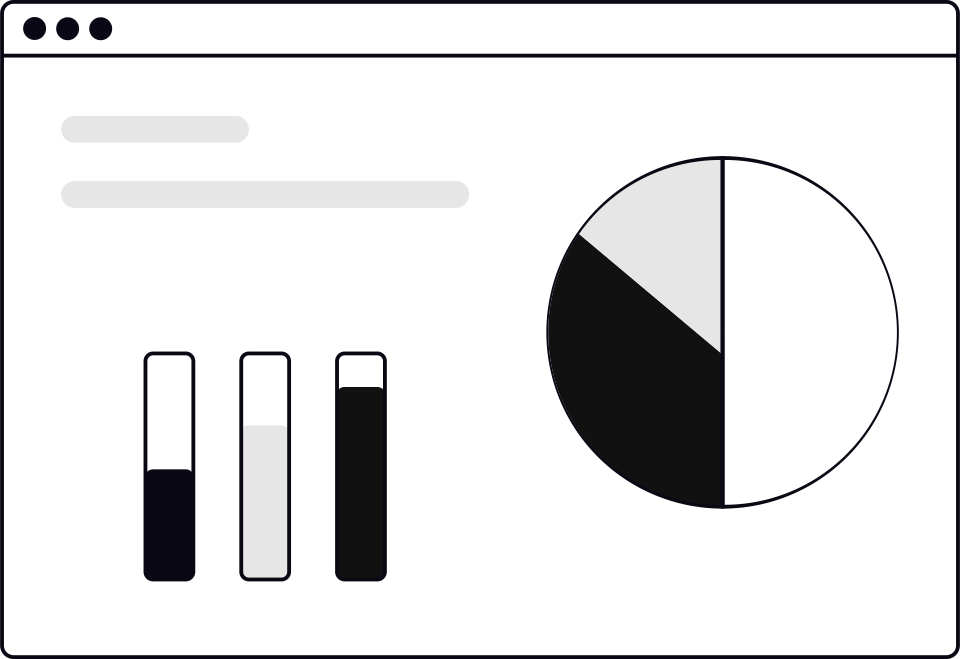
- Real-time visibility, owners see operations as they happen, not at month-end
- a system that scales with you, add branches, modules, and users without platform migration
- Managed platform, ongoing updates, security, and infrastructure without an internal development team
- Integration-ready, connect to accounting, payments, and communication systems
Project Planning Considerations

Every custom software project is shaped by business requirements rather than a fixed feature list. The final scope is influenced by workflows, user roles, integrations, reporting needs, security requirements, and future scalability.
| Consideration | Why It Matters |
|---|---|
| Business Workflows | More operational rules require more engineering and planning |
| User Roles & Permissions | Different access levels increase system complexity |
| Third-Party Integrations | Connecting existing platforms requires additional solution design |
| Reporting & Dashboards | Accurate reporting depends on structured data and consistent workflows |
| Security & Compliance | Access control, audit history, and data protection should be planned from the beginning |
| Scalability | Systems should support future growth without requiring major redevelopment |
Every business operates differently, which is why successful software projects begin with understanding processes rather than assigning a fixed price. A well-planned platform is designed around operational requirements and can evolve as new departments, integrations, and business functions are introduced.
Common questions
What is an ERP system?
An ERP (Enterprise Resource Planning) system is integrated software that manages core business processes, operations, customers, inventory, and reporting, in a single platform with shared data.
Do SMEs need ERP?
SMEs need operational systems. Whether you call it ERP, business management software, or a job tracking platform depends on complexity. If you manage jobs, customers, and inventory, you need what ERP provides, at a scale appropriate to your business.
How is custom ERP different from SAP or Microsoft Dynamics?
Custom ERP is built around your specific workflow at a fraction of the cost and timeline. Enterprise ERP implements industry-standard templates with extensive configuration. Custom ERP is engineered for your process.
Can you add modules after launch?
Yes. We build modular systems. Launch with core workflow, add inventory, reporting, or mobile access in subsequent phases.
How do you handle data migration from spreadsheets?
We map existing data fields to the new schema, build import scripts, validate records, and run parallel systems during transition to ensure nothing is lost.
Scope Your ERP System
Walk us through your operation from start to finish. We will map it to an ERP structure and quote the modules you need.